

How to Choose the Right Fruit and Vegetable Jelly for Your Brand?
Release time: 2026-10-29
Table of Contents
Choosing the right jelly product for your brand involves more than selecting a flavor or attractive package. For food distributors, wholesalers, and private-label brands, the decision also affects product positioning, order volume, production costs, and long-term supply stability. A product that fits your target market but requires excessive inventory or offers limited customization may not be the best commercial choice.
When sourcing fruit and vegetable jelly, buyers should evaluate the product itself alongside the manufacturer’s production capabilities and customization options. Understanding these factors before placing an order can help reduce purchasing risks and make it easier to develop a product line that meets customer expectations.
What Factors Matter When Choosing Fruit and Vegetable Jelly?
The first step is to define your target customers and intended market position. Some brands may want a convenient snack for everyday consumption, while others may focus on distinctive flavors, portable packaging, or products designed for specific retail channels. Your positioning should guide decisions about product specifications, packaging, and pricing.
Flavor selection is another important consideration. Familiar flavors may be easier to introduce to an established customer base, whereas distinctive combinations can help a new product stand out. However, adding more flavor options can complicate inventory management and increase the number of items you need to test before launch. Ask the supplier which flavors are already available and whether new flavor development is possible.
Ingredients and product labeling also deserve attention. Buyers should review the ingredient list, nutritional information, serving size, and applicable product claims before approving a product for their market. Rather than relying only on promotional descriptions, request the relevant product documentation and make sure the final presentation matches local food regulations.
How Does Packaging Affect the Marketability of Jelly Products?
Packaging influences how customers perceive a product and how easily retailers can display, store, and sell it. For individual consumers, convenient portion sizes and easy-to-carry packaging may be attractive. For distributors, packaging dimensions, carton quantities, storage requirements, and shipping efficiency can be equally important.
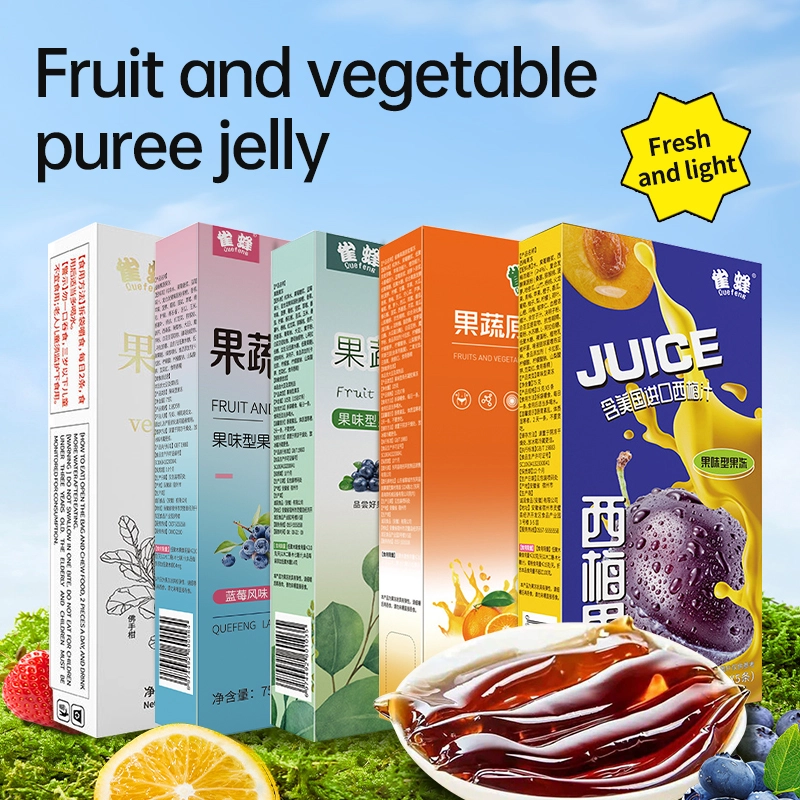
For example, Quefeng fruit and vegetable jelly is supplied in individual 15 g portions, with seven pieces per box, giving a total net weight of 105 g per box. This format provides a defined serving size and can be evaluated for retail shelves, online product listings, or other suitable distribution channels.
Before confirming an order, ask whether the supplier offers private-label packaging, customized artwork, or different packaging specifications. Confirm which elements can be changed, such as the brand logo, colors, language, and label information. Custom packaging should be assessed not only for appearance but also for production lead time, minimum order quantities, and the additional costs involved.
What Should Wholesale Buyers Compare Before Ordering?
When sourcing wholesale enzyme jelly, buyers should compare more than the quoted unit price. A lower price may not represent better value if the supplier cannot meet delivery schedules, provide the necessary documentation, or maintain consistent product specifications across orders.
Minimum order quantity is particularly important for new brands. A large initial order may reduce the unit price, but it can also tie up working capital and increase the risk of unsold inventory. Before committing, estimate likely sales volume, storage capacity, expected shelf life, and the time required to replenish stock.
Buyers should also clarify production lead times, payment terms, shipping arrangements, and the process for handling quality concerns. If samples are available, evaluate them before confirming a bulk order. The approved sample, product specifications, and final packaging should be clearly documented so that both parties understand what the order must deliver.
Key Purchasing Considerations for Fruit and Vegetable Jelly
| Purchasing Factor | What to Check |
| Product & Flavor | Available flavors and ingredients |
| Packaging | Package size and private-label options |
| MOQ & Pricing | Minimum order quantity and unit cost |
| OEM/ODM Service | Customization scope and lead time |
| Quality & Compliance | Product documents and target-market requirements |
Use these points as a starting framework when comparing suppliers. Request written confirmation of the specifications and commercial terms that matter to your business before placing an order.
How Can OEM/ODM Services Help Build Your Jelly Brand?
OEM and ODM services can help brands develop products that align more closely with their market positioning. OEM arrangements generally focus on producing goods according to an agreed specification, while ODM services may include a broader role in product development and formulation. The exact scope varies by manufacturer, so buyers should confirm what each supplier can actually provide.
For brands exploring OEM/ODM fruit and vegetable jelly, customization may involve packaging design, private-label branding, flavor selection, or other product-development requirements, depending on the manufacturer’s capabilities. Not every request will necessarily be available for an existing product, and changes to formulations or packaging may affect minimum order quantities, costs, and production schedules.
Before starting a customized project, prepare a clear brief covering your target market, preferred packaging, expected order volume, and launch timeline. Ask the supplier which specifications can be customized and which must remain unchanged. You should also confirm sample approval procedures, artwork requirements, and who is responsible for checking the final label information.
A practical approach is to begin with an existing product where possible, then assess whether additional customization is commercially justified. This can help brands evaluate market demand before investing in a more complex development project.
What Should You Check Before Selecting a Jelly Manufacturer?
A reliable manufacturer should be able to explain its production capabilities, product specifications, quality procedures, and order requirements clearly. Buyers should request relevant business and food-production documentation and verify that the product can legally be supplied to the intended market.
For export orders, requirements may include ingredient declarations, nutritional labeling, language-specific packaging, import documentation, and compliance with local food regulations. These requirements differ by destination, so they should be checked before packaging artwork is finalized or production begins. Do not assume that documentation sufficient for one market will automatically satisfy another.
It is also useful to evaluate communication and order management. Can the supplier provide clear quotations, confirm production timelines, explain customization limitations, and respond to questions about product quality? These factors can affect the purchasing experience as much as the initial price.
Anhui Chengrun Biotechnology Co., Ltd. offers Quefeng fruit and vegetable jelly, with OEM/ODM services available. The listed product has a 12-month shelf life and a minimum order quantity of 5,000 boxes. Buyers should confirm current availability, applicable customization options, final pricing, and export requirements directly with the manufacturer before placing an order.
FAQ
What is the minimum order quantity for Quefeng fruit and vegetable jelly?
The listed minimum order quantity is 5,000 boxes. Confirm the current MOQ and whether customized packaging or other requirements affect the order quantity.
Can fruit and vegetable jelly be customized for a private-label brand?
OEM/ODM services are available, but the scope of customization depends on the product and the manufacturer’s capabilities. Ask about branding, packaging, flavor options, development costs, and production lead times.
What is the shelf life of Quefeng fruit and vegetable jelly?
The listed shelf life is 12 months. Buyers should confirm the manufacturing date, storage conditions, and remaining shelf life at the time of shipment.
What should importers check before placing an order?
Importers should review product specifications, ingredient and nutritional information, packaging labels, food-production documentation, and the requirements of the destination market. Confirming these details before production can help prevent labeling and customs-related issues.