

How to Choose a Freeze-Dried Coffee Powder Manufacturer for Your Private Label Brand?
Release time: 2026-10-01
Table of Contents
Launching a private-label coffee product involves more than finding a supplier with a competitive price. Brands also need to consider taste, packaging, minimum order quantities, quality control, and delivery schedules. Choosing the right freeze dried coffee powder supplier can make it easier to develop a product that fits your target market and maintain a consistent customer experience as your business grows.
For businesses exploring new coffee products, Chengrun Bio offers food and beverage product development and OEM/ODM customization options. Before choosing a manufacturing partner, it is worth understanding what different suppliers can provide and which details deserve closer attention. Whether you plan to sell bottled instant coffee through retail channels or source products for wholesale distribution, a clear purchasing plan can help you avoid unnecessary costs and delays.
Define Your Target Market and Product Positioning
Before contacting a freeze dried coffee powder manufacturer, start by deciding who will buy your product. A coffee brand targeting office workers may prioritize convenient packaging and quick preparation, while a distributor serving supermarkets may focus more on shelf presentation, retail pricing, and packaging sizes. Food and beverage companies developing products for other brands may have different requirements for customization and order volume.
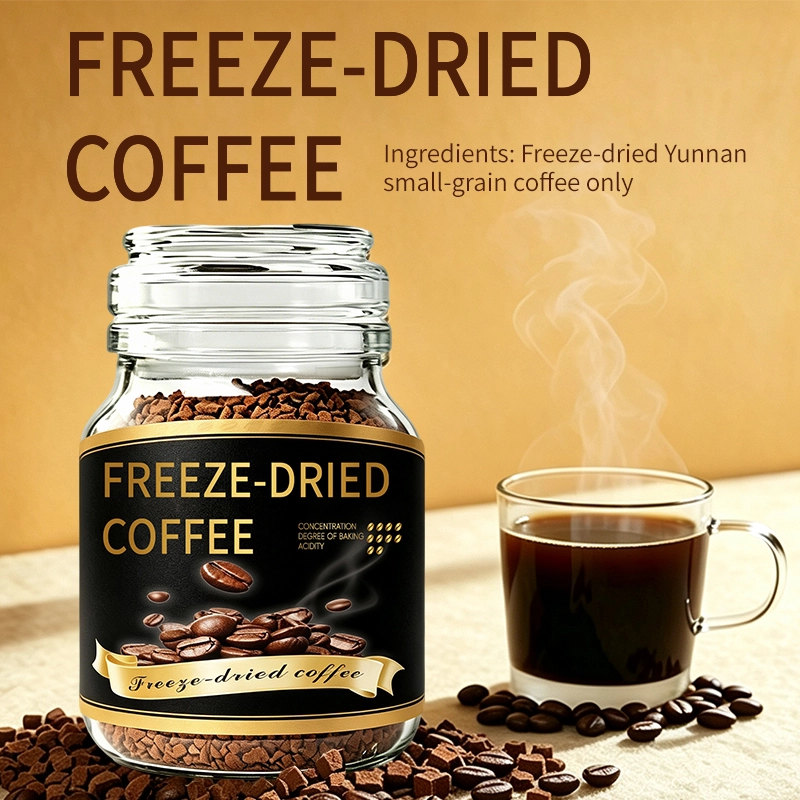
Your target market will influence almost every purchasing decision, including product specifications, packaging materials, flavor preferences, and expected price points. For example, bottled freeze-dried coffee powder may suit customers who want a compact container that is easy to store and use. A larger package may be more appropriate for households or food service buyers with higher consumption needs.
It is also helpful to research competing products before finalizing your specifications. Compare their package sizes, ingredient information, positioning, and price ranges. This gives you a practical starting point when discussing product options with suppliers and helps ensure your product has a clear place in the market.
Evaluate Coffee Quality and Batch Consistency
Product quality should be one of your first considerations when comparing suppliers. Even if two products have similar specifications, their aroma, flavor, texture, and performance after mixing may differ. These characteristics can influence customer satisfaction and repeat purchases, particularly when your brand depends on delivering a consistent experience.
When evaluating freeze-dried coffee, check its aroma, solubility, color, and flavor consistency across batches. If possible, request samples and prepare them under the conditions your customers are likely to use. Check how the coffee dissolves, whether the flavor meets your expectations, and whether the finished drink suits your intended product positioning. For wholesale buyers, testing samples before committing to a large order can reduce the risk of purchasing a product that does not fit the market.
Consistency also matters beyond the initial sample. Ask how the supplier manages production batches, handles quality deviations, and maintains product specifications over time. A reliable partner should be able to explain its procedures clearly and provide relevant product documentation. Do not base your decision on a sample alone; consider how the supplier will maintain quality throughout an ongoing business relationship.
Check Private Label and OEM/ODM Customization Options
For brands building their own product lines, customization can be just as important as the coffee itself. A supplier may provide different options for container sizes, labels, branding, and outer packaging. However, the available services vary, so it is important to confirm the details rather than assume every request can be accommodated.
Ask whether the supplier supports private-label production, OEM/ODM services, or both. Clarify whether you can customize existing products or whether your requirements would involve additional product development. You should also discuss label artwork, packaging materials, logo placement, sample approval, and any related setup charges before production begins.
A clear approval process helps prevent misunderstandings. Before placing an order, confirm which party is responsible for supplying packaging designs, reviewing label information, and approving the final sample. If your product will be sold in a specific country, check that the proposed label can accommodate the applicable ingredient, nutrition, and regulatory information.
The goal is to find a partner whose customization capabilities match your business plan. Extensive customization may be useful for an established brand, while a simpler private-label option may be more practical for a new product launch.
Compare MOQ, Packaging, and Total Purchasing Costs
The quoted unit price is only one part of the purchasing decision. Before ordering, confirm the minimum order quantity (MOQ), package configuration, production lead time, and whether the supplier has stock available. These details affect how much working capital you need and how quickly you can bring the product to market.
For example, when sourcing 100g bottled coffee powder, confirm the net weight per bottle and the number of bottles per box. Do not assume that a supplier’s quoted MOQ refers to individual bottles; it may be calculated by box or another packaging unit. Getting this information in writing makes it easier to calculate the actual order quantity and plan warehouse space.
You should also compare the full cost of purchasing freeze-dried coffee powder wholesale, including product pricing, customized packaging, sample development, freight, and other applicable charges. Ask whether the quoted price changes with order volume and whether customized orders follow a different delivery schedule from stocked products.
Finally, match your first order to a realistic sales forecast. Ordering more than you can sell may tie up cash and increase storage pressure, while ordering too little could make replenishment difficult. A practical supplier should explain its order terms clearly so you can plan purchases with fewer surprises.
Review Quality Management and Export Requirements
If you plan to sell coffee across borders, product documentation and regulatory requirements need attention early in the process. Start by asking for the relevant product specifications, ingredient information, nutrition data, shelf-life details, and recommended storage conditions. Confirm that the supplier can provide the documents required for your intended market.
Food regulations and labeling rules vary by country. Depending on the destination, you may need to verify requirements concerning ingredient declarations, nutrition labeling, language, packaging claims, and import documentation. Your supplier may be able to provide supporting information, but you should independently confirm the rules that apply to your business and product.
It is also worth checking the manufacturer’s food production qualifications and any claimed quality certifications. Verify that the documents are current and cover the relevant facility, activities, or products. A certification name alone does not guarantee that every product meets every destination market’s requirements.
For long-term cooperation, ask how production batches are identified, how quality complaints are handled, and what happens if a shipment does not meet the agreed specifications. Clear procedures and complete records can make it easier to manage risks as your order volume increases.
Confirm the Details Before Placing a Bulk Order
Before committing to a large purchase, take time to confirm the practical details with your supplier. Ask whether samples are available, what the MOQ covers, and whether the proposed packaging is already available or requires customization. You should also clarify the expected production schedule, payment terms, shipping arrangements, and the process for approving the final product.
For private-label projects, confirm who will review the packaging artwork and product information before production. If your business has specific requirements for flavor, container size, or labeling, document them in the purchase agreement or approved specifications. Verbal assurances are less useful than clear, written terms that both parties can reference.
Finally, consider the supplier’s communication and problem-solving approach. A supplier who responds clearly to questions and explains limitations upfront may be easier to work with over time than one who focuses only on offering the lowest quotation. The aim is not simply to complete one order, but to establish a dependable supply arrangement that supports your brand’s growth.
Chengrun Bio works with businesses in the food and beverage sector and offers OEM/ODM customization options. If you are exploring a new coffee product, discuss your project requirements, packaging preferences, and purchasing plans with the team. Before placing an order, confirm the specific product’s manufacturing arrangements, MOQ, sample availability, and delivery terms directly with the supplier.
FAQ
What is the difference between freeze-dried coffee and regular instant coffee?
Freeze-dried coffee is a type of instant coffee made by removing water from prepared coffee under low-temperature conditions. Flavor, aroma, and dissolution performance depend on the raw materials and production process, so sample testing is still important.
Can I sell bottled freeze-dried coffee powder under my own brand?
Potentially, yes. It depends on the supplier’s private-label or OEM/ODM capabilities, available packaging options, and minimum order quantity. Confirm customization details before placing an order.
What should I check when buying freeze-dried coffee powder wholesale?
Review product samples, specifications, MOQ, packaging configuration, shelf life, delivery time, and relevant quality documents. Include packaging and shipping costs when comparing quotations.
How can I choose a reliable coffee powder supplier?
Compare product consistency, customization capabilities, quality management, communication, and supply capacity. Request samples and verify the supplier’s documentation before committing to a large order.